The Shift #2: Seniority Beyond Execution Mastery
Technical seniority used to be measured by what you knew. Now, it is measured by what you allow. As AI automates the 'how,' a Senior Engineer's value has moved from execution mastery to the ruthless management of intent and technical debt.
<Haringey, Winter 2025. Writing this while watching birds flying …>
What actually defined "technical seniority"?
For a long time, the answer was a mix of shelf-life and scars. It was the number of years spent wrestling with specific tools, the hard-won ability to anticipate risks before they happened, and a mental library of "how" to implement complex logic from scratch. You were senior because you were the fastest at navigating syntax and the most reliable at technical execution.
But recently, the ground has moved.
A few weeks ago, I read an article from Hugging Face giving Claude the ability to handle the full lifecycle of model fine-tuning—picking hardware, writing scripts, and running SFT/DPO loops while the engineer sleeps. For me, this isn't just an efficiency gain; it's a fundamental change in our value proposition. When the "how" becomes a free, instant commodity, seniority is no longer defined by what you can build, but by what you allow to be built.
The Re-Alignment of Seniority
In the old world, a senior's value was defined by Execution Mastery. Because building software was difficult, expensive, and slow, seniority was measured by the ability to overcome technical friction—wrangling complex PyTorch code, debugging exploding gradients in a 50-layer network, or tracing CUDA OOM errors due to memory leaks.
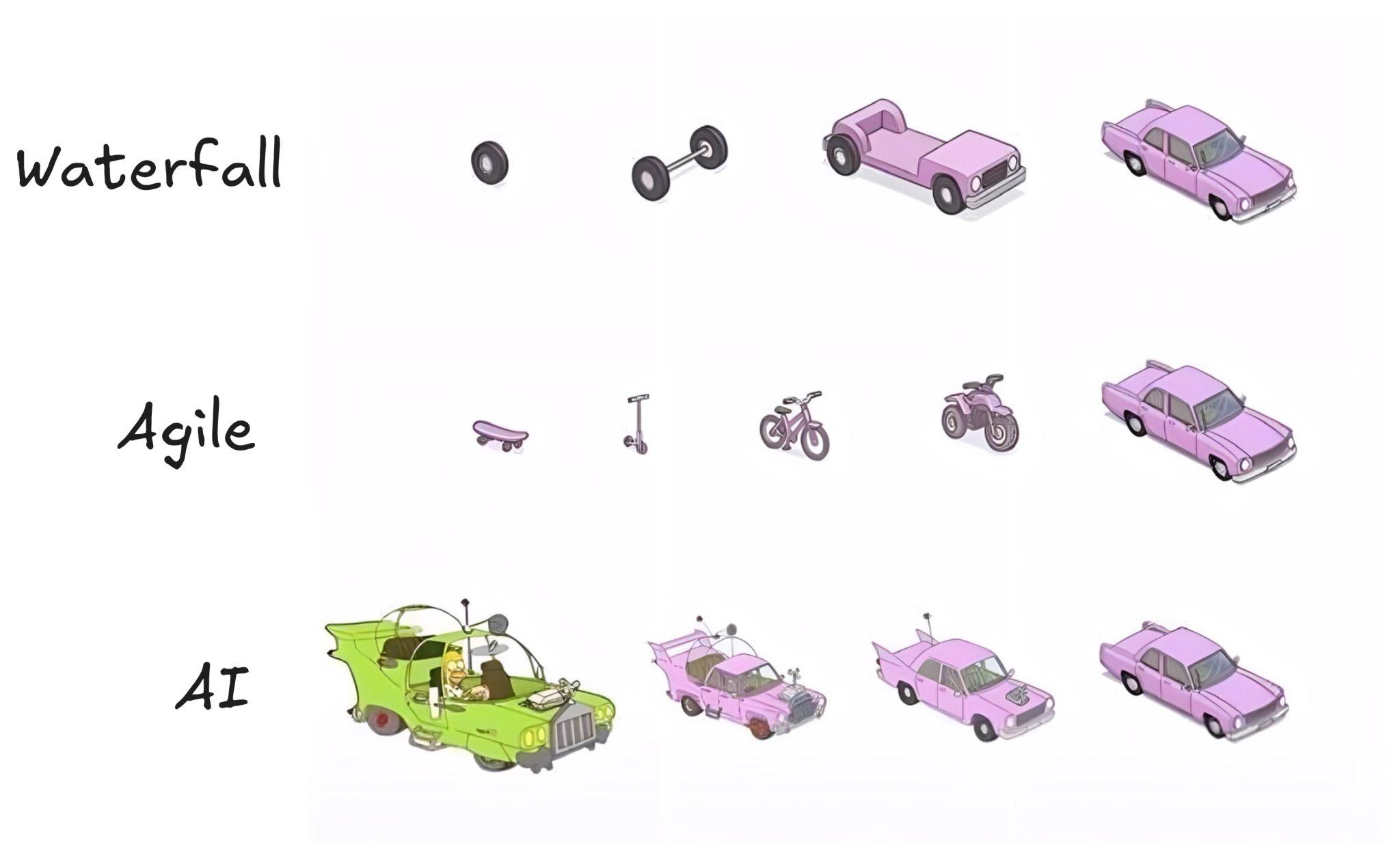
AI Development process requires trimming, not crafting, image credit: https://www.linkedin.com/posts/eordax_ai-genai-agents-activity-7337058689033326592-sMib/
Today, AI has removed the friction of implementation, but it has increased the noise. Seniority is now measured by Strategic Curation. If the AI acts as the "Implementation Engine", the Senior Engineer must become the Architect of Intent.
- Old Seniority (The Craftsman):
- Focus: Overcoming the difficulty of creation.
- Value: "I know how to build this efficiently and correctly when others get stuck."
- Superpower: Deep technical depth and precision in execution.
- New Seniority (The Guardian):
- Focus: Managing the risks of abundance.
- Value: "I know why we shouldn't build this, even though the AI makes it easy."
- Superpower: System-level intuition, validation, and constraint management.
Seniority is no longer about knowing the answer; it's about having the judgement to ask if the question is worth answering in the first place.
The "Vibe-Coding" Trap
The dangerous trend in this new era is "vibe-coding"—building things because they feel high-tech, rather than because they provide utility. Even Big Tech isn't immune.
I was recently looking at the new EKS Global Dashboard from AWS re:Invent. Technically, it's a feat: a centralised view of every cluster across every region and account (previously we had to write our own script to list and manage the clusters). But when you look at the default layout, it feels like it was "vibe-coded" by an AI that prioritised data volume over utility.
At the very top (default layout, 2025-12-21), you see 3 dashboards "Top accounts by number of clusters", "Top organizational units by number of clusters" and "Top regions ...".
- The Junior Perspective: "This is great, I can see everything at once!"
- The Senior Perspective: "Who cares which region has the most clusters? Show me which clusters are running outdated versions so I can avoid the extra AWS charges".
Seniority is the filter that removes the noise. It is the ability to look at an AI-generated solution and say, "This is technically impressive, but it's a distraction".
Tip
There is an old idea in philosophy called Occam's Razor: among competing explanations that fit the facts, prefer the one that makes the fewest assumptions. In engineering, the same instinct applies—among solutions that work, the simplest one that satisfies the real constraint usually wins on reliability, cost, and changeability.
Managing "Irreversible" Technical Debt
I hear the sceptics: "AI creates massive technical debt". They are right. AI-generated code is often a black box of "consensus-driven" patterns that might work today but break tomorrow (usually due to a lack of context, rather than capability of AI). However, this trend is irreversible. You cannot compete by banning AI; you compete by managing the debt it creates.
Seniority in the AI era is no longer about avoiding debt at all costs; it is about Strategic Risk Management. It is about knowing which technical debt is worth taking to hit a market window and which parts of the system are too critical to be left to the AI assistant.
| Feature | Old Seniority (The Craftsman) | New Seniority (The Guardian) |
|---|---|---|
| Expertise | Deep Specialization (Knowing the deepest internals of the tool) | Broad Orchestration (Connecting any tool the AI suggests) |
| Code | Execution Mastery (Writing efficient syntax from scratch) | System Guardianship (Validating logic & safety) |
| Communication | Translation & Feasibility (Explaining technical constraints to stakeholders) | Intent & Alignment (Filtering AI noise to focus on business value) |
| Debt | Refactoring (Cleaning code to maintain long-term velocity) | Containment (Isolating "vibe-coded" parts from critical systems) |
The Bottom Line
If you are still measuring your value by your ability to write complex code or design multi-cloud architecture, you are competing with a tool that doesn't sleep and costs pennies.
The "Shift" is moving us away from being implementation engines toward becoming curators of quality. We are the ones who must ensure the math works, the ethics hold, and the business logic is sound.
My new rule for seniority: Don't just implement. Validate.
Tip
A Senior's New Checklist:
- The Razor Test: Am I adding this complexity because it solves a user problem, or because the AI made it easy to generate? (If in doubt, cut it).
- The Debt Audit: If I commit this AI-generated code today, do I understand it well enough to debug a production outage at 3 AM tomorrow?
- The Intent Check: The AI solved the "How" (implementation), but have I rigorously validated the "Why" (business alignment) and the "What if" (edge cases)?