The Shift #6: The Future of Jobs ... in the next 10 and 100 Years
AI isn't the end of work; it's the rise of the orchestrator. A look at the 'horizontal collapse' of tech jobs, and a cosmic blueprint for the next century.
<Haringey, March 2026. Happy International Women's Day. To those who are feeling lost ...>
Lately, the conversations that hit me hardest haven't been about the latest model benchmarks or new agentic frameworks. They've been quiet, heavy discussions with close friends. Over the last few months, I've watched brilliant, dedicated people - engineers and builders I deeply respect - get swept up in a wave of mass layoffs.
Back home, we would have handled this the way we always do: pulling up a couple of plastic chairs at a local spot and letting them vent over a few beers. Instead, being thousands of miles away, these heavy moments have unfolded entirely through screens - watching a typing indicator pause and start again as a friend tries to find the words for what just happened.
But as the initial shock fades and the dust begins to settle, a different, more resilient truth is revealing itself. We are not watching the end of human work. We are living through a profound, albeit painful, metamorphosis. We are transitioning from specialists into orchestrators. All those years you spent mastering your craft, internalizing logic, and building systems - none of that is obsolete. It is simply demanding a new form.
Here is an honest look at the reality we are facing today, and where the very concept of a "job" is heading - not just in the next decade, but into the next century.
The Recent Reality: What the Data and the Builders Tell Us
The anxiety many are feeling is backed up by recent data. Anthropic's new research, Labor market impacts of AI: A new measure and early evidence, paints a stark picture of Large Language Model penetration. In occupations categorized under Computer & Math, LLMs touch 94% of tasks. In Office & Admin, it's 90%.
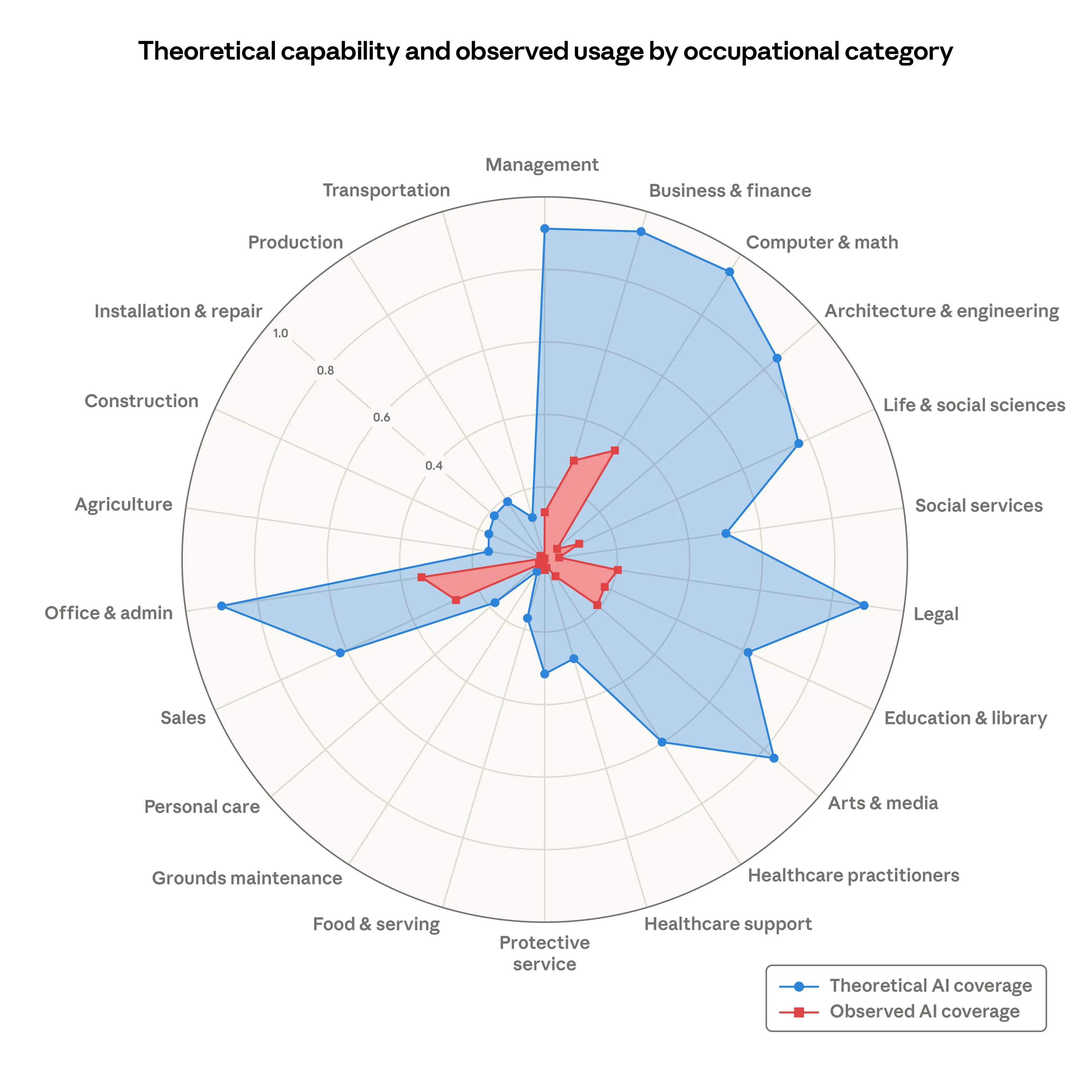
Anthropic - Theoretical capability and observed exposure by occupational category
However, there is a crucial gap between theoretical capability and observed exposure. For instance, Claude currently covers just 33% of all tasks in the Computer & Math category. We are still in the early days of adoption, but the ceiling is undeniably high.
What this means for us is a phenomenon known as "horizontal collapse". Traditional software engineering roles are converging. We are moving away from writing pure syntax and toward a single meta-competency: orchestrating agentic AI systems to achieve outcomes.
You don't have to look far to see this in practice. Andrej Karpathy recently shared his experiments testing this exact shift. He set up an environment where a human acts as a "chief scientist" orchestrating multiple AI agents (four Claude, four Codex) working independently in isolated environments.
It's messy right now, but the trajectory is clear: the engineer of tomorrow is a manager of agents.
The Next 10 Years: The Era of the Meta-Competency
Over the next decade, we will see traditional job titles dissolve. As AI continues to commoditize the execution of hard skills - writing code, drafting reports, crunching data - the premium will shift entirely. The value will no longer be in the syntax of creation, but in the architecture of outcomes.
What exactly is this "meta-competency"? It is the ability to orchestrate agentic systems to solve complex, messy problems.
If an AI can write flawless Python or perfectly optimize a cloud infrastructure architecture on its own, the human's value is no longer in doing the math or typing the script. The human's job is defining the business constraints, understanding the physical context, and directing teams of AI agents to execute. The job becomes pure Systems Thinking. We will move from being builders of software to being solvers of reality, using AI as our primary lever.
Because while AI is incredibly smart in the digital realm, it is totally blind to the physical friction of the real world. That gap is where our jobs will live.
Consider a scenario I think about often: a software engineer displaced by the horizontal collapse who decides to return to their hometown to open a traditional Phở restaurant. On the surface, it looks like a defeat, a complete departure from tech. But in reality, it's a redeployment. They apply their meta-competency - systems thinking, optimization loops, and agentic automation - to inventory management, local supply chains, and the customer experience. The medium changes from code to broth, but the engineering mindset makes the physical business thrive in a way a traditional owner couldn't.
We see a poignant exploration of this exact dynamic in the film Upstream. Gao Zhilei is a 45-year-old high-level IT programmer who has spent his life climbing the corporate ladder, only to be laid off - a victim of corporate restructuring and AI-driven efficiency. Forced to pivot, he begins delivering food as a Meituan shipper.
Gao quickly realizes that the delivery app's algorithm, designed for pure digital efficiency, is blind to physical reality: broken elevators, confusing apartment layouts, and hidden shortcuts. The AI cannot map the friction. Using his background as a programmer, he develops a specialized mini-program to map these real-world obstacles for himself and his fellow riders.
In Upstream, Gao doesn't "overcome" his situation by magically getting his high-paying IT job back. His victory is deeper. It is a profound lesson in letting go of the ego attached to a job title, realizing that his ability to perceive a flawed system and orchestrate a solution remains immensely valuable, no matter the context.
In the next ten years, our jobs will be found exactly there: in the messy, unmapped spaces where perfect AI algorithms collide with the imperfect physical world.
The Next 100 Years: Cosmic Blueprint for 22nd Century
If the next 10 years are about applying AI to everyday life and terrestrial friction, my prediction for the next 100 years is that we will use these exact same agentic systems to scale humanity beyond our physical limits.
Historically, our ambition has always been bottlenecked by our capacity for manual execution. We can dream up a Dyson Sphere or a terraformed Mars, but we couldn't possibly write the millions of lines of code or coordinate the billions of robotic actions required to build them. But as I watch AI execution rapidly become a commodity, I keep asking myself: what happens next? I believe we look up.
In the 22nd century, I see the concept of a "job" elevating entirely. We will no longer be the executors of tasks; we will be the architects of intent, directing vast, automated ecosystems on a cosmic scale. Here is how I envision our roles evolving:
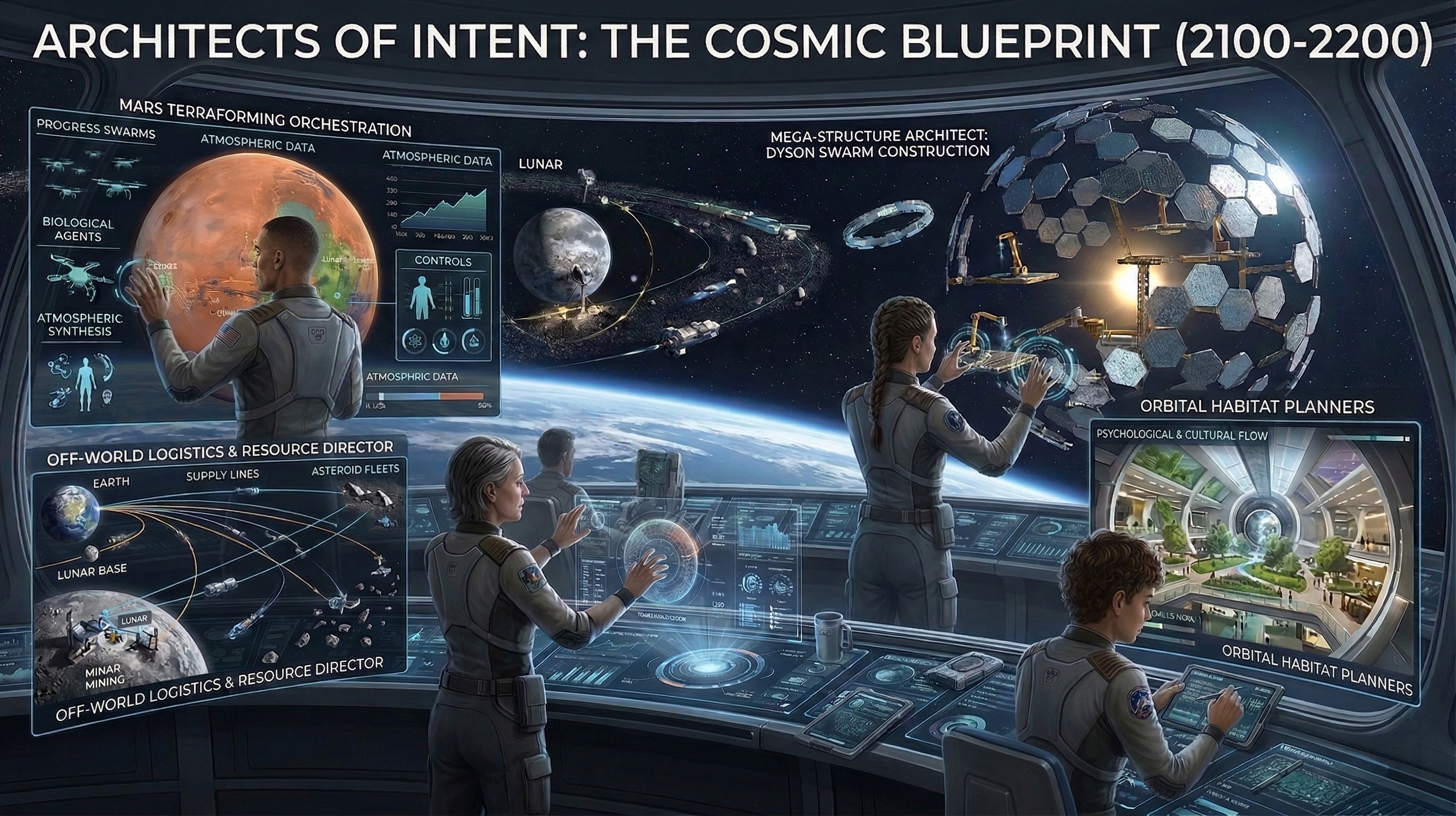
Cosmic Blueprint for 22nd Century
Planetary Ecosystem Orchestrators
I don't believe we will be writing scripts to control individual rovers. Instead, a Terraforming Orchestrator on Mars will manage swarms of specialized agentic AI. You will define the biological and atmospheric parameters, and billions of micro-drones and synthetic biological agents will execute the plan - adjusting soil alkalinity, synthesizing greenhouse gases, and cultivating habitats. The job won't be coding the drones; it will be balancing the macro-system.
Off-World Resource and Logistics Directors
Right now, we spend our time building agentic systems to optimize cloud infrastructure and manage operational ecosystems across data centers. In 100 years, I predict that exact same systems-thinking will apply to the solar system. Near-Earth Asteroid (NEA) Prospectors will manage automated mining fleets. Lunar Base Logistics Directors will oversee the intricate supply chains connecting Earth, orbital waystations, and permanent Moon settlements. It will be the ultimate exercise in resource optimization.
Macro-Structure Architects
Building mega-structures like a Dyson Swarm requires coordination far beyond human cognitive limits. I foresee the Architects of the 22nd century working symbiotically with AI - setting the physical constraints and safety boundaries while the AI calculates the orbital mechanics and directs the automated manufacturing foundries in space.
Orbital Habitat Planners
If we are going to live in massive rotating space stations or lunar colonies, the AI will perfectly handle the life-support math - calculating oxygen recycling, radiation shielding, and artificial gravity. But a human will need to design the actual experience of living there. I foresee Habitat Planners focusing entirely on the psychological and cultural flow of these artificial cities. You will direct agentic systems to simulate, test, and build out architectural layouts, ensuring that living in a steel tube millions of miles from Earth still feels deeply human and feels like home.
Tip
Highly recommend watching Youtube channel Kurzgesagt – In a Nutshell for high-quality videos about space and the future of humanity.
Letting Go to Move Forward
The hardest part of this shift isn't learning how to orchestrate an LLM. It's the ego death of the specialist. For years, we have wrapped our entire sense of self around specific titles - the "Senior Developer", the "Data Scientist", the "CV/ML Engineer". The pain of the horizontal collapse comes from having those labels violently stripped away.
But if you can look past the shock, there is a profound liberation in letting go. When we stop clinging to the identity of the "coder" and detach our ego from the syntax we write, we realize we are not our tools. What remains is the pure mind: the intent that perceives a problem and the logic that designs a solution. Code was always just a translation layer. Now, that layer is just getting thinner.
This reflects the fundamental Buddhist concept of Vô thường - Impermanence. It reminds us that suffering arises not from change itself, but from our desperate clinging to states that are naturally meant to evolve. The rigid roles we held were never permanent structures. When we release our grip on how things used to be and embrace this impermanence, our hands are finally free to build what comes next.
"After all... tomorrow is another day." - Scarlett O'Hara
<Credit> Director: Tin Hoang | Editor: Gemini 3.1 Pro | Graphic Designer: Nano Banana 2