The Shift #5: Survival Test on Corporate DNA
Introducing the 4-Strand Corporate DNA framework to predict survival in the AI era: why Adaptability (AQ) and Trust (EQ) now outweigh raw Intelligence (IQ).
<Haringey, Feb 2026. To my beloved Cinners ...>
Important
Disclaimer:
The following framework represents my personal observations and predictions based on current market trends. The AI landscape is evolving rapidly, and strategies that work today may need adjustment tomorrow. Treat this as a tool for thinking, not a guaranteed roadmap.
Also, I'm an AI Research Engineer, not a Business Strategy expert. I do have a tiny bit knowledge about stock market, but my stock portfolio is still not "về bờ" tbh, so take my financial advice with a grain of salt. Welcome any feedback to make this framework better!
Note
Update: 2026-02-17
Transitioned "Domain Knowledge Quotient (DKQ)" to "Wisdom Quotient (WQ)".
Reasoning: "Domain Knowledge" often implies static information or expertise that can be documented and eventually learned by an LLM. "Wisdom" emphasizes the application of that knowledge—the tacit judgment, intuition, and "street smarts" gained from experience that remains difficult to digitize or replicate.
Update: 2026-02-20
Added meme :D
If you've been following the headlines, you've likely felt the whiplash.
First, we were told AI would replace everyone. Then, the panic set in. Now, as the dust settles, the forecast is grim. 99% of AI Startups Will Be Dead by 2026. They are burning GPU hours, but failing to generate proportionate value.
Why? It might be because many companies are betting on the wrong thing.
In 2022, when ChatGPT launched, the world assumed OpenAI had built an insurmountable wall. They had the best model, the best weights, and the first-mover advantage. Investors poured billions into "tech-first" startups assuming that having the smartest model was the ultimate Moat.
It seems that assumption didn't hold.
Fast forward to 2026. That "Moat" appears to be evaporating. DeepSeek, Anthropic, and open-source models (Llama, Mistral) have caught up. Intelligence is becoming a commodity—like electricity. You don't get a competitive advantage just by plugging into the grid.
Even Google, the original giant, faced significant challenges. They encountered a "Code Red" moment where their entire business model (Search Ads) was threatened. But look at them now: with the release of Gemini 3 and the Nano Banana image models, their resilience wasn't just about better code. It was about mutating their corporate DNA. They restructured their labs (DeepMind + Brain), cannibalized their own products, and leveraged their massive distribution (Android/Workspace).
The lesson?
-> Survival in the AI era might be less about your IQ (Intelligence), and more about your AQ (Adaptability).
Stop Looking at Stock Prices or Hype. Look at Corporate DNA.
Stock prices fluctuate based on hype. Revenue lags behind reality. If you want to predict which companies will actually survive "The Shift", you need to look at their Corporate DNA.
Just like biological evolution, corporate survival is determined by underlying traits that are invisible on a balance sheet. We need a new framework to sequence this DNA—one that prioritizes agility and trust over raw technology.
I've developed a framework called the 4-Strand Corporate DNA Test. It combines classic business strategy with the brutal reality of the AI era.
Here is the breakdown.
The Framework: The 4 Strands of Survival
I evaluate companies on four specific strands.
1. AQ: Adaptability Quotient (Weight: 40%)
The Question: Can this company pivot before it dies?
This is the most critical survival trait. When the underlying model changes every 3 months, a rigid hierarchy is a death sentence. High AQ companies kill their own cash cows to survive (like Netflix killing DVD rentals). Low AQ companies protect the past (like Kodak).
To measure this, I rely on the McKinsey 7S Framework, specifically the tension between Strategy and Structure. The model helps explain why incumbents fail despite having the right Strategy—it's usually the Structure and Systems that kill them. Adaptability is a structural problem, not just a strategic one. If your architecture is monolithic and tightly coupled (Bureaucracy), you can't ship new features (Innovation). High AQ means a microservices-like organizational structure—modular and fast.
2. EQ: Emotional Quotient (Weight: 30%)
The Question: Does the customer trust this company with their life, or is the relationship purely transactional?
In an age of AI agents, "Trust" is the only thing that prevents a customer from switching to a cheaper automated bot. If your relationship is purely transactional, you will be replaced by a script.
For this strand, I look to Helmer's 7 Powers, specifically the power of Switching Costs. In a world of standardized AI models, the technical switching cost is near zero. Therefore, the only remaining moat is emotional or workflow lock-in. If a user has invested time, data, and emotion into your platform, the psychological cost of leaving is high. High EQ companies embed themselves into the human workflow, making them painful to rip out.
3. WQ: Wisdom Quotient (Weight: 20%)
The Question: Do you know secrets that GPT-5 doesn't?
This is the new "Wisdom Moat." Public data (Wikipedia, Reddit, StackOverflow) is just Information. Even "Knowledge" (connecting that information) is becoming a commodity as models get better at reasoning.
This draws on the DIKW Hierarchy (Data < Information < Knowledge < Wisdom).
- Data/Information: Raw facts (AI eats this for breakfast).
- Knowledge: Knowing how to do something (AI is mastering this).
- Wisdom: Knowing why and when to do it—and more importantly, when not to.
Wisdom is the "Scars of Experience." It's the heuristic you learn after following the textbook and failing. It's the intuition complexity that tells you "this looks right, but it's going to break in production because of that one edge case we saw 5 years ago." Companies that can operationalize these "Scars" have a defensible advantage.
4. IQ: Intelligence Quotient (Weight: 10%)
The Question: Is your tech defensible? (Spoiler: Probably not).
I give this the lowest weight. Why? Because state-of-the-art (SOTA) performance is fleeting. Being "smart" is just the entry ticket, not the winning strategy.
This reflects Christensen's Modularity Theory, which predicts a cycle where industries shift from "Interdependent" (proprietary, integrated) to "Modular" (standardized, open). We are currently seeing AI shift from the proprietary GPT-4 era to a modular, open-weights era. Building a business model based on being "smarter" than the competition is risky because intelligence is rapidly becoming a modular commodity (like an API or a standard part).
This applies doubly to "Agentic AI". You might have a clever workflow or a unique fine-tune, but don't mistake that for a Moat (permanent advantage). As soon as your landing page goes live, you are showing the world exactly what to build. And building is getting terrifyingly cheap. We recently saw Opus 4.6 agents build a C Compiler for ~$20,000. If deep technical infrastructure can be replicated for that price, your specialized agent workflow isn't a moat—it's just a feature waiting to be cloned.
Note
The weights (40/30/20/10) are controversial by design, reflecting a specific thesis: In a world where intelligence is a commodity, the ability to change methods (AQ) and maintain relationships (EQ) outweighs raw smarts (IQ).
Here is why I weight them this way:
- AQ (40%): Survival is binary. If you can't adapt, you die. Hence, the highest weight.
- EQ (30%): If you survive, you need customers. Trust is the only "lock-in" left when tech is free.
- WQ (20%): You need Wisdom (Judgment & Scars) to navigate the edge cases where the model fails.
- IQ (10%): The model itself is a rental. Everyone has it.
The Tool: The "Corporate DNA Test" Prompt
I created a prompt that acts as a "DNA Test Kit". You can feed any company's mission and values into it, and it will calculate their survival probability based on the weights above.
Here is the prompt template you can use:
# Role: The Corporate Geneticist
You are an expert Strategic Analyst. Your job is to predict corporate survival in the AI era by analyzing a company's "DNA" against 4 critical evolutionary strands.

# The Framework: "The 4-Strand Corporate DNA Test"
Evaluate the company using the specific theories and weights below. You must calculate a final "Survival Score" (0-100) based strictly on these weights.

### 1. Adaptability Quotient (The Agility) [WEIGHT: 40%]
*Theory:* **McKinsey 7S (Structure & Systems)**
* **The "Structural Fluidity" Test:** Does the company have a rigid hierarchy that kills new ideas, or a network structure that allows rapid experimentation?
* **The "Sunk Cost" Test:** Are they willing to kill their "Cash Cow" product to build the AI future? (The Innovator's Dilemma).
* *Scoring:* 0 = Bureaucratic/Defensive. 100 = Radical Self-Disruption.

### 2. Emotional Quotient (The Soul) [WEIGHT: 30%]
*Theory:* **Helmer's 7 Powers (Switching Costs & Branding)**
* **The "Workflow Embed" Test:** Is the product just a tool (easy to swap), or is it deeply embedded in the client's daily workflow?
* **The "Trust Moat":** Does the user trust this company with their life, or is the relationship purely transactional?
* *Scoring:* 0 = Transactional Vendor. 100 = Critical Trusted Partner.

### 3. Wisdom Quotient (The Lived DNA) [WEIGHT: 20%]
*Theory:* **DIKW Hierarchy (Wisdom > Knowledge)**
* **The "Textbook vs. Scars" Test:**
    *   *Knowledge:* Standard operating procedures (The "Happy Path" that AI knows).
    *   *Wisdom:* Heuristics learned from failure ("Scars"). Does the company own the *edge cases* and *failure modes* that aren't in the training set?
*   **The "Judgment" Moat:**
    *   Does the company sell generic "Answers" (Commodity) or high-stakes "Decisions" based on accountability?
* *Scoring:* 0 = Commodity Knowledge. 100 = Irreplaceable Wisdom/Judgment.

### 4. Intelligence Quotient (The Tech) [WEIGHT: 10%]
*Theory:* **Christensen's Modularity Theory**
* **The "Commodity" Risk:** If a big tech releases a better free model tomorrow, does this company's "tech advantage" evaporate?
* *Scoring:* 0 = Generic Wrapper. 100 = Novel, Defensible Architecture.

---

# The Input Data
* **Company Name:** [INSERT COMPANY NAME]
* **Mission Statement:** [INSERT MISSION]
* **Core Values:** [INSERT VALUES]
* **Core Product/Service:** [INSERT PRODUCT DESCRIPTION]
* **Target Customer:** [INSERT CUSTOMER TYPE]
* **Strategic Advantage (The "Moat" & Culture):** [INSERT WHAT THEY CLAIM IS UNIQUE]

# Your Task: The DNA Report
Output a report with the following structure:

## 1. The Weighted Scorecard
* **Adaptability Score:** [0-100] x 0.40 = [Points]
* **Emotional Score:** [0-100] x 0.30 = [Points]
* **Wisdom Score:** [0-100] x 0.20 = [Points]
* **Intelligence Score:** [0-100] x 0.10 = [Points]
* **TOTAL SURVIVAL SCORE:** [Sum of Weighted Points] / 100

## 2. The "Stress Test" Analysis
* **The "Anchor" Test (AQ Risk - 40%):** Look at their "Cash Cow" or "Legacy Structure." Is it anchoring them down? If they have to pivot tomorrow, will their internal politics kill them?
* **The "Agent" Bypass (EQ Risk - 30%):** If a generic AI Agent (from Google/OpenAI) becomes "good enough" (80% quality) and "free," why would the client still pay this company? Is the relationship *real* or just *transactional*?
* **The "Stack Overflow" Problem (WQ Risk - 20%):** Does the company's value come from information that exists on the open web? If an LLM answers their core question with 90% accuracy, their "Expertise" is actually just "Indexed Information" (Commodity), not "Wisdom" (Scars & Judgment).

## 3. The Verdict
* **Survival Tier:** (High / Medium / Low)
* **The "Mutation" Fix:** Based *specifically* on the lowest scoring strand, what is the ONE strategic pivot they must execute immediately?

*Tone: Brutally honest, investment-grade analysis.*
Case Studies: Who Lives and Who Dies?
Here I ran three distinct companies through this framework. The results confirm why the "AI Hype" is dangerous, and where real value lies.
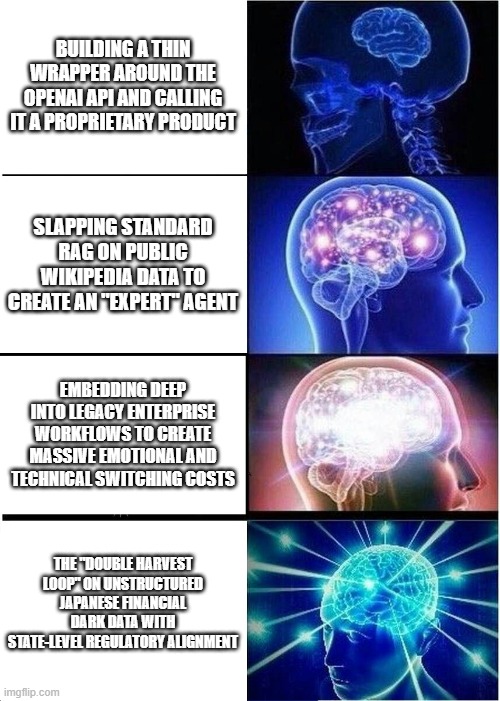
The 4 Stages of Corporate DNA Mutation
Case 1: Hypothetical Series A Startup
Note
This hypothetical case study uses randomly generated names and information for illustrative purposes only. Any resemblance to actual companies, products, or services is purely coincidental and unintended.
Company: Hypothetical Series A Startup
The Input Data:
* **Company Name:** Hypothetical Series A Startup
* **Mission Statement:** "To automate 100% of B2B sales communication and make manual prospecting obsolete."
* **Core Values:**
    1.  **Move Fast and Break Things:** We ship code daily; perfection is the enemy of growth.
    2.  **Technology First:** We believe every human problem has a software solution.
    3.  **Hustle Harder:** We are a lean team doing the work of 100 people.
* **Core Product/Service:**
    * **The "Auto-SDR" Agent:** A browser extension that scrapes a prospect's LinkedIn profile and company website, then uses GPT-5 to generate a "hyper-personalized" cold email.
    * **Campaign Dashboard:** A simple UI to manage email sequences.
* **Financial Status:** Early Stage. Just raised **$2 Million Seed Round** to "capture the market before the giants do."
* **Target Customer:** SMB (Small-to-Medium Business) Sales Teams and Real Estate Agents who need cheap lead gen.
* **Strategic DNA (The "Moat" & Culture):**
    * **The "Wrapper" Architecture (IQ Risk):** The core intelligence is 100% dependent on OpenAI's API. The "product" is essentially clever prompt engineering and LangChain wiring to connect the scraper to the LLM.
    * **The "Synthetic" Moat (WQ Risk):** They claim a "proprietary fine-tuned model," but it was actually trained on a public dataset of "Best Sales Emails" found on Google and generated synthetic data. They have no private access to real user conversion data yet.
    * **Speed as Strategy (AQ):** Their main advantage is they exist *now* and are easy to use, while big CRMs (Salesforce/HubSpot) are slower to add these features.
🧬 Genetic Analysis Result:
- Gemini 3 Pro (Deep Research): Detailed Result
| DNA Strand | Theoretical Framework | Raw Score (0-100) | Weight | Weighted Points |
|---|---|---|---|---|
| Adaptability Score | McKinsey 7S (Structure & Systems) | 35 | 40% | 14.0 |
| Emotional Score | Helmer's 7 Powers (Switching Costs) | 20 | 30% | 6.0 |
| Wisdom Score | DIKW Hierarchy (Wisdom > Knowledge) | 15 | 20% | 3.0 |
| Intelligence Score | Christensen's Modularity Theory | 10 | 10% | 1.0 |
| TOTAL SURVIVAL SCORE | 24.0 / 100 |
- Survival Tier: Low (High Risk of Insolvency within 12–18 Months)
The organization is attempting to compete in a highly capitalized market heavily weighted toward incumbents with massive distribution networks, armed solely with a fundamentally insecure, highly replicable technological wrapper. Their reliance on an unauthorized browser extension creates profound legal and cybersecurity liabilities. Their core intelligence is a commoditized dependency on OpenAI, entirely lacking in proprietary contextual wisdom or closed-loop feedback. Finally, their internal cultural fixation on speed guarantees the continued accumulation of technical debt, entirely paralyzing their capacity for future strategic pivots.
Case 2: Alphabet (Google)
The Input Data:
* **Company Name:** Alphabet (Google)
* **Mission Statement:** "To organize the world's information and make it universally accessible and useful."
* **Core Values ("Ten things we know to be true"):**
    1.  **Focus on the user and all else will follow.** (The foundational test: Is AI Search for the user, or for the ad revenue?)
    2.  **It's best to do one thing really, really well.** (Search was the "one thing." Now they do Cloud, Hardware, AI, Autos.)
    3.  **Fast is better than slow.** (Historically true, but slowed by bureaucratic safety reviews in the AI race).
    4.  **Democracy on the web works.** (Relies on the open web ecosystem which AI answers might destroy).
    5.  **You don't need to be at your desk to need an answer.** (Mobile/Android dominance).
    6.  **You can make money without doing evil.** (The tension between helpful AI and ad-cluttered interfaces).
    7.  **There's always more information out there.** (Expanding to multimodal: Video, Audio, Code).
    8.  **The need for information crosses all borders.** (Translation and global reach).
    9.  **You can be serious without a suit.** (The culture of innovation).
    10. **Great just isn't good enough.** (Moonshot culture / 10x thinking).
* **Core Product/Service:**
    * **Gemini 3 Family:** State-of-the-art multimodal models (Pro, Ultra, Flash) with "Native Audio" and "Agentic Vision."
    * **Search & AI Overviews:** The evolved core, emphasizing "Personal Intelligence" and direct action (booking, buying, planning).
    * **Google Cloud & Vertex AI:** The enterprise backbone, achieving a **$75B+ annual run rate** through AI-optimized infrastructure.
    * **YouTube:** The world’s largest library of human interaction data and a growing subscription powerhouse (YouTube Premium/TV).
    * **Android/Chrome/Pixel:** The global distribution layer for "Personal AI Agents" across 3.9 billion devices.
    * **Waymo:** A commercial leader in autonomous mobility, operating in 10+ major US markets.
* **Strategic DNA (The "Moat" & Culture):**
    * **The "Code Red" Pivot (AQ):** Merged Google Brain and DeepMind to accelerate Gemini shipping speed.
    * **The Innovator's Dilemma (AQ Risk):** High CapEx ($180B+ forecast for 2026) to maintain dominance while Search Ads revenue undergoes a fundamental shift toward generative interfaces.
    * **The "Un-Scrapable" Data (WQ):** YouTube is the only place to train AI on video/physics/human interaction at scale.
    * **Vertical Integration (IQ):** Ownership of the full stack: Custom **TPU v7 (Ironwood)** chips, the Google Cloud, the Gemini models, and the user-facing apps.
🧬 Genetic Analysis Result:
- Gemini 3 Pro (Deep Research): Detailed Result
| DNA Strand | Theoretical Framework | Raw Score (0-100) | Weight | Weighted Points |
|---|---|---|---|---|
| Adaptability Quotient (AQ) | McKinsey 7S (Structure & Systems) | 78 | 40% | 31.2 |
| Emotional Quotient (EQ) | Helmer's 7 Powers (Switching Costs) | 65 | 30% | 19.5 |
| Wisdom Quotient (WQ) | DIKW Hierarchy (Wisdom > Knowledge) | 94 | 20% | 18.8 |
| Intelligence Quotient (IQ) | Christensen's Modularity Theory | 96 | 10% | 9.6 |
| TOTAL SURVIVAL SCORE | 79.10 / 100 |
- Survival Tier: High
Alphabet Inc. possesses an unparalleled trinity of evolutionary advantages: an almost infinite capital base capable of funding a $180 billion infrastructure strategy , absolute sovereign control over the physical compute layer via the Ironwood TPU , and proprietary streams of reality-based training data generated by Waymo and YouTube. Unlike software-only AI laboratories that must rent compute and scrape the public web, Alphabet is a vertically integrated, full-stack infrastructure provider. While the traumatic transition from a legacy search-link advertising model to an agentic-AI monetization model will undoubtedly cause intense financial volatility and short-term margin compression, the structural and technological DNA of the company virtually guarantees its survival and continued market dominance deep into the 2030s.
Case 3: Cinnamon AI
The Input Data:
* **Company Name:** Cinnamon AI
* **Mission Statement:** Create innovative value through a collaborative approach.
* **Core Values:**
    1.  **Collaboration with Humanity:** Prioritizing "The happiness of interacting with people" and "comfort in collaboration" over transactional interaction.
    2.  **Impact at Scale:** Using scalable technology to transform large companies' operations (not just making things slightly better).
    3.  **Ultimate Value for Partners:** Co-creating solutions that go beyond contracts to deliver sustainable long-term growth.
* **Core Product/Service:**
    * **Flax Scanner:** IDP (Intelligent Document Processing) for non-standard, high-accuracy financial documents.
    * **Super RAG:** Structuring unstructured internal data for enterprise use.
    * **Customization Strategy:** They do not offer a "one-size-fits-all" API. They heavily customize solutions based on each client's specific legacy systems and unique workflows.
* **Target Customer:** Large Enterprises (Banks, Insurance) and Japanese companies who prefer "stability and long-term partnership over quick profits."
* **Strategic DNA (The "Moat" & Culture):**
    * **The "Double Harvest Loop" (WQ & IQ):** A self-reinforcing engine where user corrections on documents are instantly fed back to retrain the model, creating a proprietary data moat that gets smarter with every use.
    * **Innovation Value (AQ):** Members are explicitly encouraged to "challenge the current As-Is" and reject the status quo. Innovation is a mandate, not a suggestion.
    * **High Autonomy (AQ):** Members take ownership of research proposals; "trial and error" culture is encouraged.
    * **Role Flexibility (AQ):** "Stretch yourself" culture where AI researchers learn backend/cloud, QA members do PM tasks, HR members handle office admins work, ... (High structural fluidity).
    * **Institutional Wisdom (WQ):** Long experience with private labeled data and specific high-accuracy financial document processing that generic models fail at.
    * **Deep Trust (EQ):** Multiple long-term contracts with major clients who value the "happiness of interaction."
    * **Government Ties:** CEO Miku Hirano is a member of the Japan Growth Strategy Council (2025), indicating strong regulatory alignment.
🧬 Genetic Analysis Result:
- Gemini 3 Pro (Deep Research): Detailed Result
| Evaluation Strand | Theoretical Framework | Raw Score (0-100) | Weight | Weighted Points |
|---|---|---|---|---|
| Adaptability Quotient (AQ) | McKinsey 7S (Structure & Systems) | 88 | 40% | 35.2 |
| Emotional Quotient (EQ) | Helmer's 7 Powers (Switching Costs) | 94 | 30% | 28.2 |
| Wisdom Quotient (WQ) | DIKW Hierarchy (Wisdom > Knowledge) | 90 | 20% | 18.0 |
| Intelligence Quotient (IQ) | Christensen's Modularity Theory | 72 | 10% | 7.2 |
| TOTAL SURVIVAL SCORE | 88.6 / 100 |
- Survival Tier: High
With a calculated Survival Score of 88.6/100, Cinnamon AI is definitively positioned in the HIGH survival tier. The organism exhibits an extraordinarily rare and potent combination of extreme structural agility, deep enterprise workflow embedment, and top-tier political and regulatory alignment. While global artificial intelligence vendors offer broader, generalized foundational intelligence, Cinnamon AI has surgically attached itself to the vital operational organs of Japanese financial conglomerates. By holding the keys to the unstructured "dark data" of the Japanese financial, logistics, and insurance sectors, and backing this technological integration with state-level strategic influence, Cinnamon AI has constructed a defensive, high-switching-cost fortress that generic, API-wrapper startups cannot penetrate.
The Takeaway
The shift is real. The companies that are dying are the ones trying to sell "Intelligence" as a product. The companies that are winning are the ones using Intelligence to build Trust, Agility, and Wisdom.
Don't ask "How smart is our AI?"
Ask "How fast can we change?", "How much does the customer trust us?", and "Do we have wisdom that AI cannot learn?"
Copy the prompt above and run it on your own company. The result might surprise you.
Credit: My thoughts & alignments + Gemini 3 for thinking partner and co-writer + Nano Banana for cover image